As I’ve mentioned on the blog before, I have a compulsion for reinventing the wheel. If I get an idea for something I’ve never seen knit before, I like to try to figure out how to do it before I go looking around to see if anyone else has done it.
T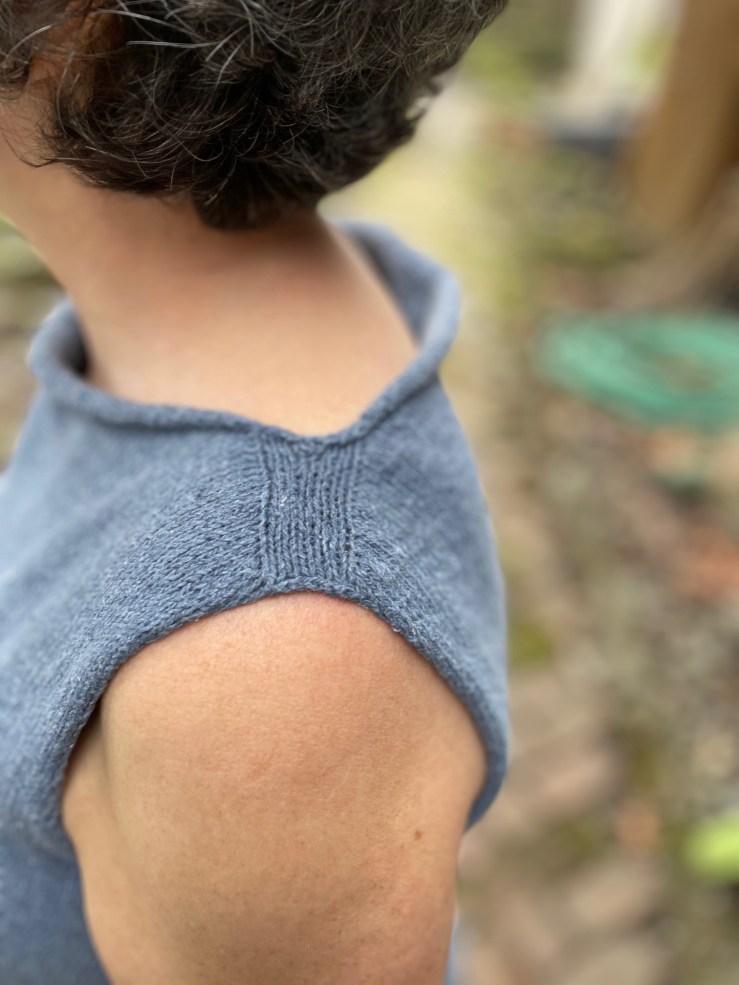 hat happened a few years ago when I was working on a basic raglan sweater. I thought, why can’t I just work a raglan with increases on every round at the beginning to build the shoulder, then go straight down from there to make the armhole, and end up with a more precise fit? So I tried it, and it fit beautifully! That will not come as a surprise to people familiar with this really rather common shoulder construction, as I later found, but for me there is joy in “discovering” it for myself.
One of the problems with raglans is that they work best for very standard sizes. For someone like me, with narrow shoulders and a bust a bit larger than average, working a raglan to fit my bust measurement results in a sloppy collar, droopy shoulders, and too much fabric at the underarms, but working it to fit my shoulders results in a tight, stretched-out bust and not enough room at the hips. Virtually all store-bought clothing has these fit problems on me.
So I made my top-down, hand-knit tops to fit at the shoulders, used increases or short rows at the bust, and made the waist and hips with just the right amount of room to move around in. For the first time in my adult life I had tops that fit. It made me feel happy to wear them.
At that point I had started writing patterns, and I thought I ought to try to write a pattern for a top like this, but one that could be easily customized to fit people of different shapes. Some knitting patterns will tell you that you have the option of altering them but don’t really tell you how. Others have formulas and long explanations for calculating alterations, or charts listing increase counts for each measurement. But surely there’s a way to write a pattern that doesn’t require you to do math or search through charts?
In my first version of the pattern, I ended up with three sets of bust instructions for smaller, mid-range, and larger sizes, but I felt like I was over-thinking it and making the pattern unnecessarily complicated. A person could easily get lost trying to figure out which instructions applied to them.
Why not just have everyone knit to fit the upper chest, then compare that size to the bust and follow instructions for adding whatever amount of extra room was needed? I could make adjustment instructions sized not to the bust or the upper chest, but to the difference, if any, between them. Eureka!
I started with just short row shaping at the bust, but I quickly realized that wouldn’t work for busts considerably larger than the upper chest, because there wouldn’t be enough vertical space for all the rows you would need. So I combined the short rows with increases, which made it possible to have just one page of instructions for everyone. And I felt like a genius.
Has anyone else written patterns this way? Probably, but I’ve never seen a pattern that does, so I like to think of it as my own invention.
The pattern is called Coolsville, and it will fit.
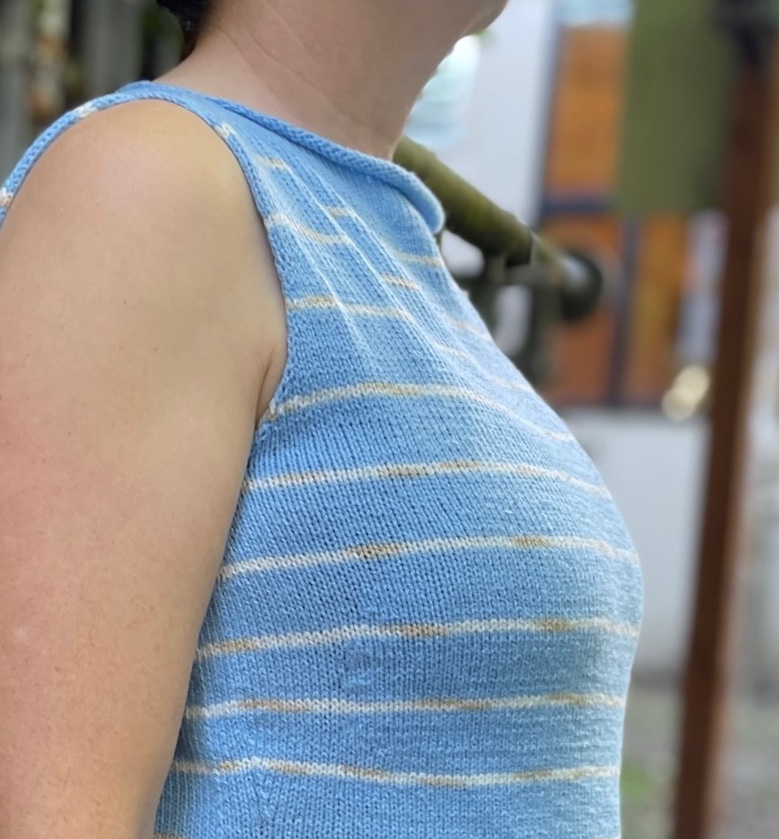
There’s more about the pattern here and on the Ravelry pattern page.

