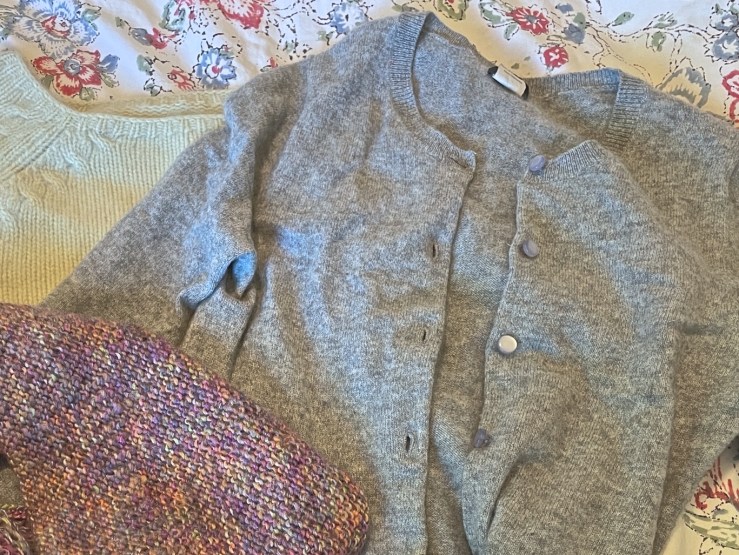
Few things make me feel more clever and all-powerful than taking a knit item that’s the wrong size or is truly ugly and destroying it to make something beautiful. You find an unloved, ill-fitting waste of fiber on the thrift store rack, lovingly dismantle it, and reform it to your will. And in the process you get grams and grams of beautiful yarn for a tiny fraction of the price of new. You’re a genius.
But first you need to choose your yarn wisely. Not all old knits will offer up usable yarn. A few snags or stains are not a problem – you can discard those portions when you unravel the fabric. But some aspects of wear, and garment construction, need to be considered when deciding whether to repurpose yarn.
Moths!
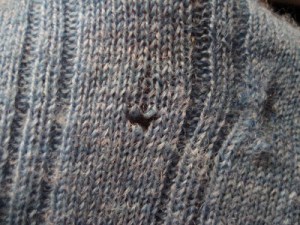
If there are multiple very small holes that can’t be explained by wearing at the elbows or stapling accidents, they may be moth holes. Moth holes often look as if a few strands of yarn have been snipped with a tiny implement, which is exactly what happened (see photo). If little gritty bits of something like sand shake out of the fabric, that’s another clue that it might be moth infested. That is probably moth poop.
Moth eggs can nestle in seams and cuffs and stay viable for a long time, and they’re notoriously difficult to get rid of. But if you love the yarn and must have it, put the item in a separate, sealed plastic bag or other non-porous container the moment you purchase it, and take immediate measures to isolate and remove the moths as soon as you get the fabric home.
First, wash the fabric (instructions here) – separately from any other items – and hang it to dry outdoors.
Then give it the temperature treatment. Moths are tough little critters, but they’re picky about temperature. Place your find in an oven set to 125 degrees F / 52 degrees C for at least three hours, or in a plastic bag in the freezer for at least a week. Then let it rest and return to room temperature without disturbing it. Both of these temperature treatments have worked for me, but I can’t guarantee that your oven or freezer will do the trick.
See this Consumer Reports article for more information on moths in clothes.
Fiber Breakdown
Sadly, some old knits are just too worn out to be useful. The poor things are dissolving, preparing to re-enter the great circle of matter, and the yarn is too weak to take any more pressure. If a garment’s fabric is wearing thin, if it sheds textile dust when touched, if you can see through it, it’s probably too old to use. The yarn would just break frequently and knit up to a garment that won’t last.
Garment Construction
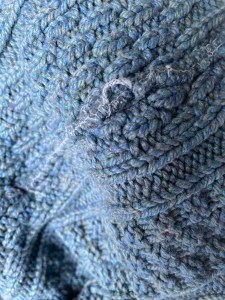
Seams that are machine-sewn with a thread that’s much tougher or tighter than the body of the fabric can make it hard to dismantle a garment without breaking the yarn you’re trying to collect. If it looks like you’ll need a seam ripper on nearly every knit row, then that garment probably won’t repurpose well.
Another thing to consider is whether a garment’s pieces have been knit to shape or cut to shape. Many store-bought sweaters are made by cutting out pieces from flat bolts of knitted fabric and sewing them together just as you would woven fabric. This is especially true for synthetics, because the cost of wasted fiber is so low.
So look inside the garment you want to repurpose and examine the seams. Was the garment cut, serged, and sewn with what looks like ordinary sewing thread, like the one in the photo above? That means that instead of one long, lovely strand of yarn, the dismantling would give you hundreds of very short, useless pieces of yarn.
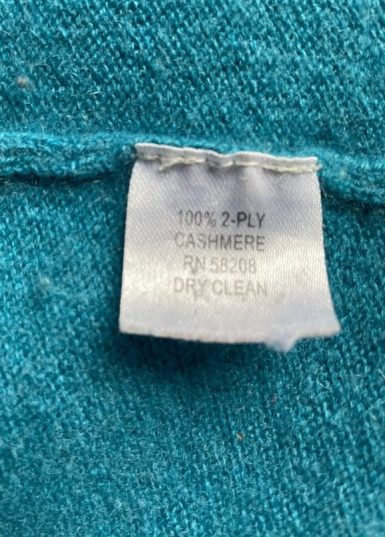
Most animal fiber yarns, however, and especially luxury fabrics like cashmere, have pieces knit to shape before they’re sewn together, wasting none of the fiber. The seams of this sort of sweater have very tidy edges, carefully stitched through the aligned knit loops along the edge of the piece, just as you do when hand knitting. These are usually a breeze to dismantle, provided they are not old and delicate, or badly felted.
Felting
Any used knitted fabric will have felted to some extent. Yarn that’s a bit felted can still be excellent for re-knitting. Old yarn that’s slightly felted can in fact have a lovely fuzziness, and take on a new life and new stitch definition when you make something new with it. But yarn that’s very felted, especially if it’s a delicate fiber to begin with, is often more trouble than it’s worth. It will be tough to unravel, and may break frequently. Check to make sure you can clearly see the loops of the stitches. Surreptitiously poke it with a pencil. Does it resist penetration? Then don’t use it.
The Smell
I hate to even mention it, but sometimes old knits stink. The smell of human use, of pets, of mustiness even, is usually (though not always) removable, but I’ve been thwarted in my repurposing attempts by two impossible odors: moth balls and perfume – especially laundry product perfume. If the smell is faint, it will fade over time, but if it’s strong, it’s tenacious. I’ve left sweaters hanging outside in a breeze for a week, soaked them for 2 days in vinegar water or diluted ammonia, to no avail. If the thing is truly saturated with the smell of naphthalene or that awful, cloying fabric softener perfume, it seems that nothing will get rid of it.
But once you’ve found fabric that doesn’t stink and still has some life in it, yarn that’s free of infestations and not too felted, congratulations! You’ve saved yourself a ton of money and rescued some luscious yarn to be used for a higher purpose.
Read Part 2: Washing Your Yarn.
 Looky Knits
This is super helpful and a great idea that I often forget about; buying and repurposing old knitwear. I’m eager to read about the next steps!
LikeLike
It is extremely satisfying to repurpose. I hope you find some great yarn to re-create with. Part 2, on how to clean your thrifted knits before unraveling, is posted here.
LikeLike