
So you’ve found an old sweater, scarf, or blanket suitable for repurposing (see previous post). Now what do you do with it?
Make sure it’s clean.
If the knit piece you’ve chosen has a tag with washing instructions, follow them. Put machine washables in the washing machine on a gentle cycle, and hand-wash if that’s what the tag recommends. But if the tag says to dry clean it, I just hand-wash. My goal, after all, is not to keep the old knit’s shape, but to disassemble and rebuild it. So go ahead and dump those dry-clean-only items in the bath. As a rule of thumb, if a piece of knitting is too fragile to wash, then it’s too fragile to disassemble and repurpose anyway.
And don’t worry about stain removal. We can assume the piece you’ve chosen isn’t stained all over, so any small stains in the yarn can be discarded when you disassemble it with very little loss of material.
Hand-washing
In my youth, I thought of hand-washing as something to be avoided at all costs. But I love wool, and I especially love repurposed cashmere, merino, and other fancy fibers that cost a small fraction of the price of equivalent yarn bought by the skein, so spending a little time hand-washing is well worth the trouble.
And there are ways to make hand-washing easier. For instance, I have never purchased special hand-washing soap for washing my knits. I just use the same gentle shampoo I use on my own head, and it works fine. It has a mild scent I like, too, so it helps to make the yarn smell nice and fresh.
Unless the item you’re washing is extremely dirty or smelly, use a very diluted concentration of soap or shampoo. One generous squirt into a large bowl or pot of room temperature water will do. Just as when washing your own hair, the idea is to remove the dirt and dust without entirely stripping the yarn of its natural lipids.
Soak
Get the whole garment wet and then let it soak for 15 or 20 minutes. You can leave it in longer if it’s particularly dirty or you’re particularly busy.
Wash
After soaking, gently swish, turn, and squeeze the garment a few times. To prevent felting, try to avoid rubbing the fibers together.
Now pour out the wash water and squeeze all the water you can out of the garment without wringing or stretching it. If the wash water is extremely discolored, then it still needs some washing, so give it another soapy bath just like the first. I like to use a large see-through bowl I have so that I can easily see what the water looks like beneath the soapy surface.
Rinse
Once your wash water is more or less clear, empty the basin and squeeze the soap out of the fabric. Now fill the bowl with plain cool water and gently swish it around again. Lift it and squeeze to look and feel for the soap. Repeat this rinse step with fresh water two or three times, or until the rinse water is clear. If you need to rinse five times or more to remove the soap, you’re probably using more soap than you need.
The Smell Test
Once you’ve washed and rinsed your fabric, squeeze out the water and give it a sniff. Washing can bring out scents in a fabric that you didn’t notice before, and even a hint of a smell can become unpleasant once your yarn is repurposed and your lovely new knit is laying against your skin or right under your nose.
Every type of fiber has its own natural smell. Most people love the smell of clean cotton. Some dislike the smell of wet wool, but that scent will more or less disappear once the fabric is dry. I like the strange, slightly sweet smell of silk, and can often tell a fabric is made with silk just by smelling it. These natural scents are all I want to smell when I work with a fiber. If any other smell is present, it’s got to go, or I’ll never be able to enjoy my new-to-me yarn.
Desmellification
If your wash and rinse water is running clear but you still notice a smell in the fabric, give it an overnight soak in a solution of 1/2 cup vinegar or 1/4 cup ammonia per gallon of water. Then rinse it until the smell of the vinegar or ammonia is gone, and sniff again. An overnight soak in a strong concentration of borax in water works like ammonia, and without the fumes. Any strong alkaline like ammonia or borax can strip the lanolin from wool, however, so use it only as a last resort for wools. After a borax soak, you’ll need to rinse very thoroughly–many more times than with plain soap–to be sure you’ve removed every bit of borax dust from the fabric.
I haven’t done a thorough study of the matter, but in my experience vinegar or another strong acid seems to work better for perfumes, while ammonia, borax, or another strong alkaline is better at dissolving pet smells or mustiness. But some laundry perfumes are very chemically complex, so if the vinegar doesn’t work, try ammonia or borax, and vice-versa.
Unfortunately, as I mentioned in my previous post, there are some smells that simply will not go away. The worst culprits are moth balls and perfumes, especially perfumes from laundry products. I have lost the battle with these smells enough times to learn never to buy anything tainted with them.
I should also mention that sometimes the smell is coming from inside the fiber. Synthetic fabrics can absorb odor in a way that makes it impossible to remove. And some synthetics can develop an unpleasant chemical smell of their own that increases over time as the molecules in the fiber break down. I once bought a beautiful old brocade jacket at the thrift store that suddenly smelled awful when I put it in to hand wash, and the more I washed it the stronger the smell got. It must have been made of acetate, because it smelled like nail polish remover. I had to throw it away.
But if you have succeeded in removing all but the faintest hint of a smell, drying the fabric will often remove the last trace of it.
Drying
Once your garment is clean, rinsed, and de-smellified if necessary, squeeze as much of the water out of it as you can. If you have a washing machine with a spin cycle, put the item in and spin it. Don’t run a full cycle–only the spin! Then hang it or lay it flat to dry. Drying can take several hours or maybe even a couple of days, depending on humidity and temperature.
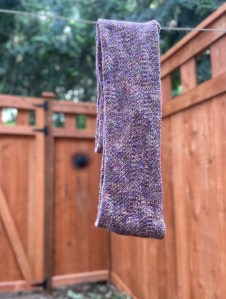
If you have some drying space outdoors on a dry day, that will be quicker, and will help to remove odors and give it a fresh smell. Running a fan aimed at your wet item can also speed the drying. Whatever you do, do not put it in the dryer!
Check front and back, inside and out, to make sure it’s dry enough for ordinary use before you begin the great unraveling.
Coming soon: Garment demolition.
 Looky Knits